



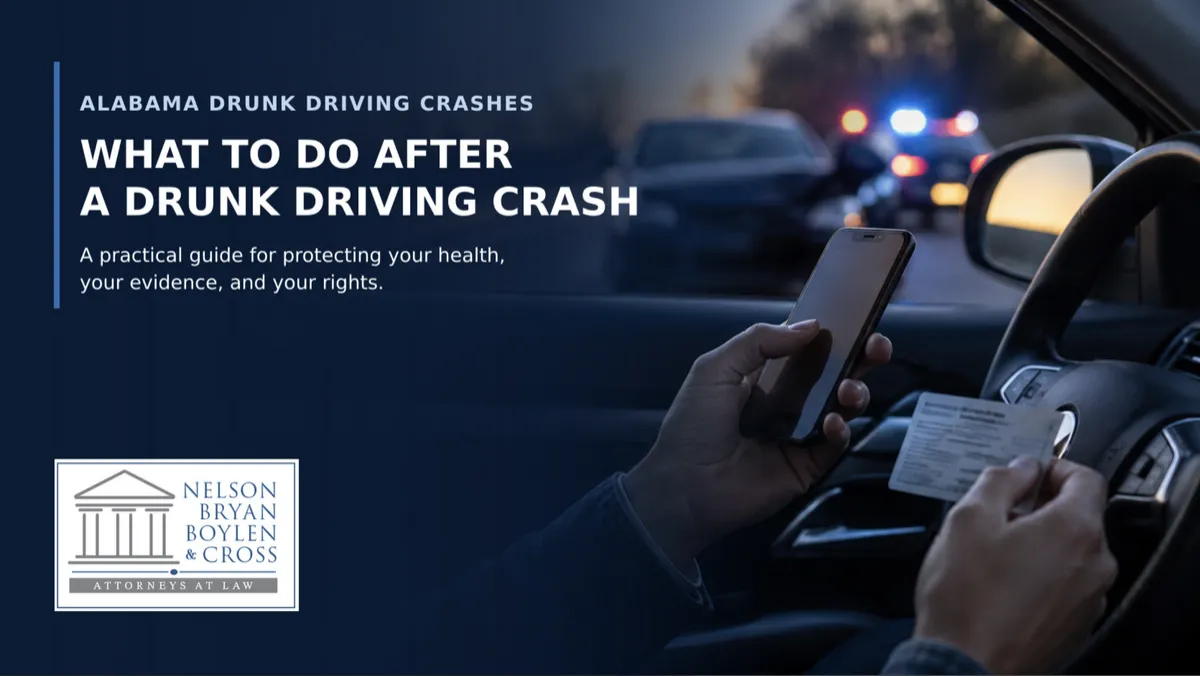
What to Do After a Drunk Driving Crash in Alabama
A practical guide for protecting your health, your evidence, and your rights.
A crash caused by an impaired driver is not an ordinary accident. In the moments afterward, victims and families are often dealing with injuries, uncertainty, and anger at the preventable choices that led to the collision. The steps taken early can make a real difference—not only for medical recovery, but also for preserving information that may later be important to an insurance claim or civil case.
At Nelson, Bryan, Boylen & Cross, we believe people injured by drunk drivers deserve careful answers and strong advocacy. Every case is different, but the following are practical steps Alabama families can take after a suspected drunk driving crash.
1. Put safety and medical care first
Call 911, accept emergency evaluation when appropriate, and follow through with recommended care. Some serious injuries, including concussions, internal injuries, and soft-tissue damage, may not be immediately obvious. Prompt treatment also creates a clear record of the symptoms, diagnoses, and care connected to the crash.
Do not minimize pain or try to “push through” it for the sake of work or family responsibilities. Keep copies of discharge instructions, prescriptions, bills, and records of follow-up appointments. If an injury affects your ability to work, document missed time and any changes in duties or income.
2. Preserve the evidence before it disappears
Law enforcement will investigate the crash, but victims should protect what they can as well. If it is safe to do so, photograph vehicle damage, the roadway, debris, traffic signals, visible injuries, and the surrounding area. Get the names and contact information of witnesses. Save photographs, videos, voicemail messages, and communications related to the collision.
Evidence in impaired-driving cases can be time-sensitive. Surveillance video may be overwritten. Vehicle data may be lost after repairs. Witness memories fade. A lawyer can take steps to request or preserve relevant records, including the crash report and other evidence that may help explain how the collision occurred.
3. Understand that a criminal charge and a civil claim are different
A DUI arrest or criminal prosecution may be important, but it does not automatically resolve an injured person’s civil claim. Criminal cases focus on whether the driver violated the law. A civil claim focuses on the losses caused by the crash, such as medical expenses, lost income, pain and suffering, property damage, and—in the most serious cases—wrongful death damages.
The facts surrounding impaired driving may also affect the types of damages available in a civil case. Alabama law permits punitive damages in certain cases involving conscious or deliberate wrongdoing, but whether they apply depends on the evidence and the circumstances. It is important not to assume that a criminal result alone answers every civil question.
4. Look beyond the at-fault driver’s insurance policy
A drunk driver may have little or no liability insurance, and even an insured driver’s policy limits may not cover the full harm caused by a major crash. That is why a careful review of all potentially available coverage matters. Uninsured/underinsured motorist coverage may be available under the injured person’s own automobile policy, a resident family member’s policy, or the policy covering the vehicle involved. The policy language and facts of the case control, so this is not something to guess about.
There may also be questions about other responsible parties. For example, the ownership and use of the vehicle, an employer relationship, or the unlawful furnishing of alcohol can require investigation. Alabama’s alcohol-liability laws are fact-specific and have changed over time. A thorough review is essential before deciding who may be legally responsible.
5. Be careful with insurance communications and quick settlements
Insurance adjusters may contact you soon after a crash. You can cooperate with reasonable requests for basic information, but be cautious about recorded statements, broad medical authorizations, or signing a release before you understand the full extent of your injuries and available coverage. A quick offer may arrive before the long-term effects of an injury are known.
Keep a simple journal of symptoms, medical visits, sleep disruption, activities you cannot do, and how the injury affects your daily life. This is not about exaggeration—it is about maintaining an accurate record during a stressful time.
You do not have to navigate the aftermath alone
After a drunk driving crash, the path forward can feel overwhelming. The right next step is often a prompt conversation with an attorney who can evaluate the facts, identify evidence that needs to be preserved, and explain the available options in plain language. At Nelson, Bryan, Boylen & Cross, we are focused on results, committed to excellence, and dedicated to advocacy for Alabama families when they need it most.
If you or someone you love has been injured by an impaired driver, contact Nelson, Bryan, Boylen & Cross at (205) 387-7777 or visit us at 1801 Corona Ave., Jasper, AL 35501 for a consultation. This article is general information and is not legal advice for a particular situation.
