



Injured by a Dangerous Road in Alabama? A Recent Court Decision Shows Why Evidence of Notice Matters
A serious accident can happen when a road contains a pothole, depression, sinkhole, uneven surface, or another dangerous condition. When the roadway is maintained by a city or other government entity, however, proving a personal injury claim may be more complicated than showing that the dangerous condition caused the accident.
A recent decision from the Supreme Court of Alabama demonstrates one of the largest challenges in these cases: proving that the municipality knew or should have known about the specific road defect before the accident occurred.
The Motorcycle Accident
On April 3, 2021, Demarco Stoudmire was riding a motorcycle on Avenue V in the Ensley area of Birmingham when he encountered a defect in the roadway. The parties disagreed about whether the condition was a pothole or a dip, so the court referred to it simply as a road defect.
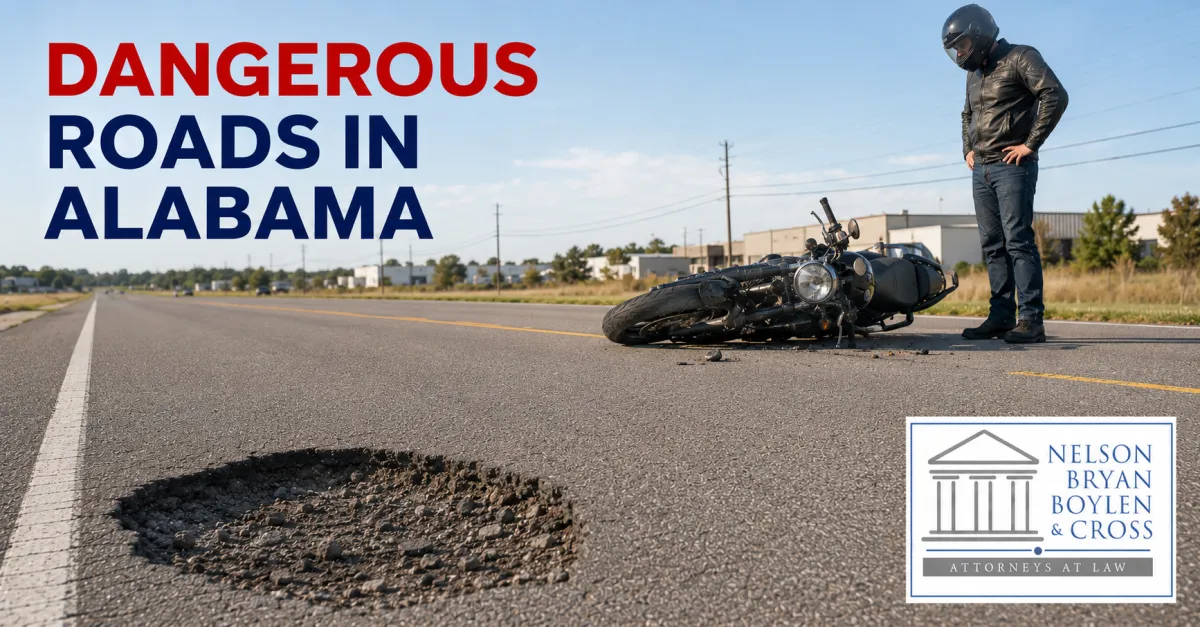
The defect allegedly caused Stoudmire to crash and be thrown from his motorcycle. He suffered severe injuries, including broken ribs and a broken collarbone that required surgery.
Approximately four months after the accident, Stoudmire submitted a notice of claim to the City of Birmingham. He later filed a negligence lawsuit alleging that the City failed to repair or remedy the dangerous condition after it had been brought to the City’s attention.
The City argued that it was protected by municipal immunity because there was insufficient evidence showing that it knew or should have known about the defect before the accident.
What Must Be Proven in a Claim Against an Alabama Municipality?
Alabama law generally provides municipalities with protection from lawsuits. However, Alabama Code § 11-47-190 recognizes certain exceptions, including circumstances in which someone is injured because a municipality failed to remedy a defect in a street, alley, public way, or public building.
To pursue this type of claim successfully, an injured person may need evidence showing that:
·The municipality had actual notice of the specific defect before the accident; or
·The defect existed for such an unreasonable length of time that the municipality should have discovered and corrected it through ordinary diligence.
These are commonly referred to as actual notice and constructive notice.
Actual notice may exist when the dangerous condition was reported to the city before the accident. This might include a 311 complaint, maintenance request, inspection record, previous accident report, or direct communication with a municipal department.
Constructive notice may exist when a dangerous condition was present long enough that the municipality reasonably should have known about it, even without proof of a specific complaint.
Importantly, the evidence generally must relate to the particular defect that allegedly caused the accident. General claims about deteriorating roads or aging infrastructure may not be sufficient.
The Evidence Presented in the Case
The City presented testimony that its 311 system contained no record of a complaint about a road defect at the location before Stoudmire’s accident. The director of Birmingham’s Department of Public Works also testified that he was unaware of any documentation showing that the City had prior knowledge of the condition.
Stoudmire presented several pieces of evidence in response. These included:
·An affidavit from a former City employee who previously encountered a large hole on Avenue V
·A written statement from a nearby resident
·A patient-care report prepared by first responders
·Information concerning another motorcycle accident allegedly involving the road condition
However, the trial court struck several of these materials from the record because of evidentiary problems. The resident’s written statement was not sworn or properly authenticated, and the patient-care report was also excluded. Part of the former City employee’s affidavit was struck as inadmissible hearsay.
The portion of the employee’s affidavit that remained did not state exactly when his incident occurred. He had worked for the City between 2003 and 2019, meaning the incident could have happened anywhere from approximately two to 18 years before Stoudmire’s accident. The evidence also did not clearly establish that the employee encountered the same road defect that later allegedly caused Stoudmire’s crash.
Why the Supreme Court Ruled for the City
The Jefferson Circuit Court initially denied the City’s request for summary judgment. The City then asked the Supreme Court of Alabama to review the municipal-immunity issue through a petition for a writ of mandamus.
On July 2, 2026, the Supreme Court concluded that the admissible evidence was insufficient to establish a genuine factual dispute over whether the City had actual or constructive knowledge of the specific defect.
The Court explained that evidence of a possibly similar road condition years earlier was not enough without a stronger connection between the two defects. The remaining evidence required speculation about whether the earlier condition was the same one involved in Stoudmire’s accident.
The Court also determined that materials created on the day of Stoudmire’s crash could not establish prior notice because they did not show that the City knew about the defect before the accident.
As a result, the Court directed the trial court to grant summary judgment in favor of the City based on municipal immunity. Several justices dissented from the decision.
What This Decision Means for Injured Alabamians
This decision does not mean that a city can never be held responsible for a dangerous road. It does show that claims involving government entities can depend heavily on the quality, timing, and admissibility of the available evidence.
Useful evidence in a dangerous-road case may include:
·Photographs and videos of the exact defect
·Measurements showing the size and depth of the condition
·The precise location of the accident
·Prior 311 calls or complaints
·Road inspection and maintenance records
·Testimony from nearby residents or business owners
·Evidence of previous accidents at the same location
·Surveillance or traffic-camera footage
·Police, fire department, and emergency medical records
·Testimony establishing how long the defect existed
Witness information should be collected promptly. A witness who knows that a defect existed before an accident may be important, but the information must be preserved in a form that can be used in court.
Special Deadlines May Apply
Claims against Alabama municipalities are subject to special notice requirements. Under Alabama law, a person asserting a tort claim against a municipality generally must present a sworn claim within six months. The notice may need to identify the date, time, place, circumstances, and damages associated with the accident.
Submitting notice within six months does not necessarily resolve every deadline or procedural requirement. Waiting can also result in the loss of physical evidence, surveillance footage, witness information, and records showing whether the dangerous condition had previously been reported.
Anyone injured because of a potentially dangerous public roadway should consider speaking with an attorney as soon as possible.
Speak With an Alabama Personal Injury Attorney
Claims involving dangerous roads and municipal entities require careful investigation. The attorneys at Nelson, Bryan, Boylen & Cross can review the circumstances, identify potential responsible parties, and determine what evidence and deadlines may apply.
For a no-cost, no-obligation consultation, call or text Nelson, Bryan, Boylen & Cross at (205) 387-7777.
